Configuring a (new) seating plan
How do I add a new seating plan in ticketmatic and configure it?
Ticketmatic supports selling tickets for seated events. Buyers have the option to automatically buy the best available seat or to select the seats they want. In order to setup a seated event, you have to create a seating plan and link it to the event. Seating plans can be reused for many events. Seating plans are managed in the Seating plans module in the Settings app.
ℹ️ Hint: To add a seating plan in ticketmatic, you first need an SVG file of the seating plan. Click Generate an SVG for seating plan for instructions on creating that SVG file.
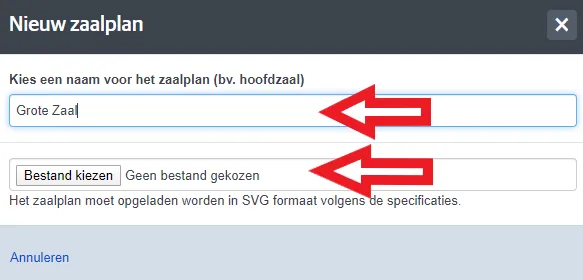
Navigate to Settings → Seating plans and click Add. Enter a name and select the correct SVG file.
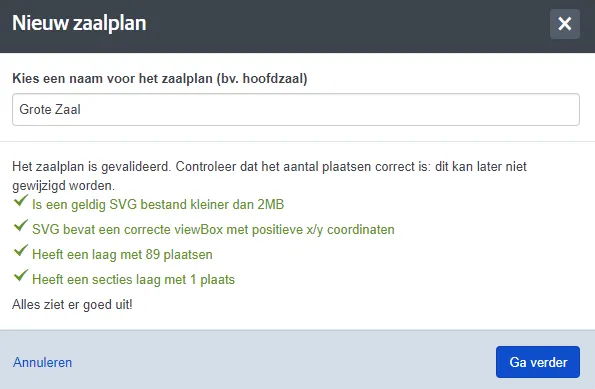
ticketmatic will now verify that your SVG file meets all requirements for use as a seating plan.
⚠️ Warning: At this stage, carefully check that the total number of seats in the venue is correct.
Now you can prepare the seating plan for use.
Assign row & seat numbers
Click the Assign row button:
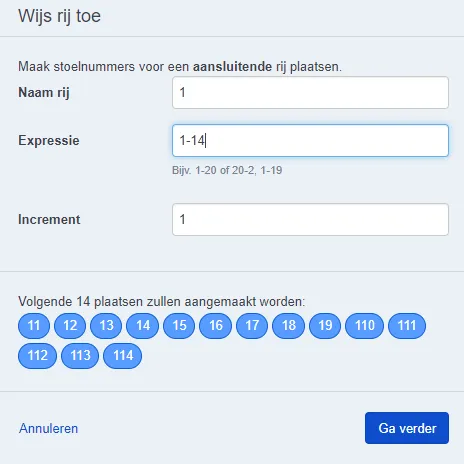
Example: configure row 1 with 14 seats
Enter 1 as row name and 1‑14 in the Expression field. Use increment 1 for consecutive numbering. For odd/even seat numbering only, use increment 2.
Seat numbers will appear in blue, combining row and seat (e.g., row 1 seat 14 → 114). Then click the blue Continue button.
Now assign numbers to seats by clicking each seat, starting from seat 1. If the row is straight, click the first seat, hold Shift, and click the last seat to assign the entire row at once.

Blue lines connecting seats indicate they form a single row. Assign seats to each row. If a row is interrupted (e.g., by a step or technical area), assign each section separately.


🚫 If you assign all seats in one go, they become linked—even across large gaps—so seat 6 and seat 12 could be treated as adjacent when they aren’t.

For left-odd and right-even numbering, enter the following expression/increment:

Example expressions:
- 1-9 inc 1 → 1,2,3,4,5,6,7,8,9
- 1-9 inc 2 → 1,3,5,7,9
- A-D inc 1 → A,B,C,D
- 1-9,10-2 inc 2 → 1,3,5,7,9,10,8,6,4,2
- 1-3,6,9,11-13 inc 1 → 1,2,3,6,9,11,12,13
Once seat numbering is correct, click Save in the top right.
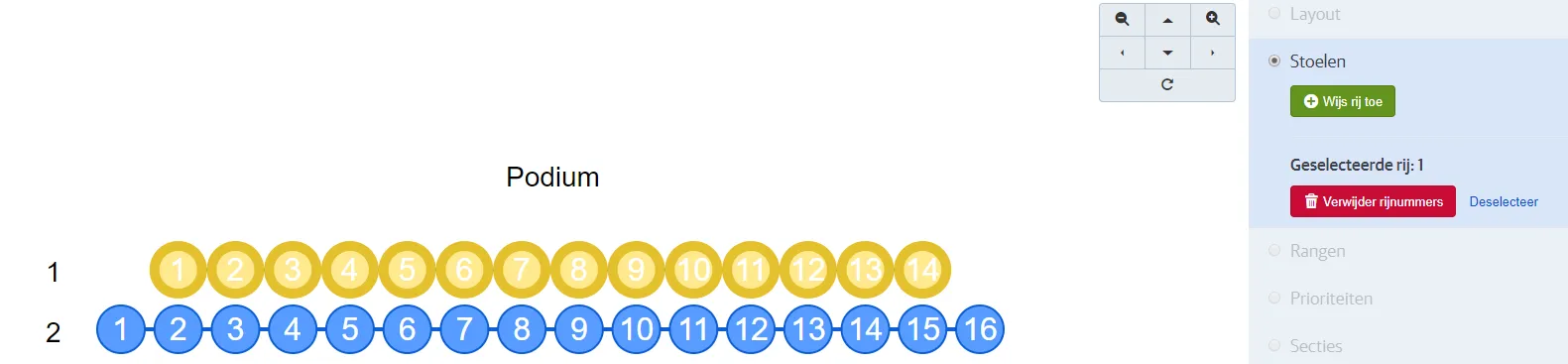
ℹ️ Hint: Made a mistake? Click the row you want to adjust, choose Remove row numbers, and start over.
Categories (Ranks)
Click Ranks on the right to assign categories to seats. The left panel shows available ranks and assigned seat counts. By default, all seats are assigned to the highest rank.
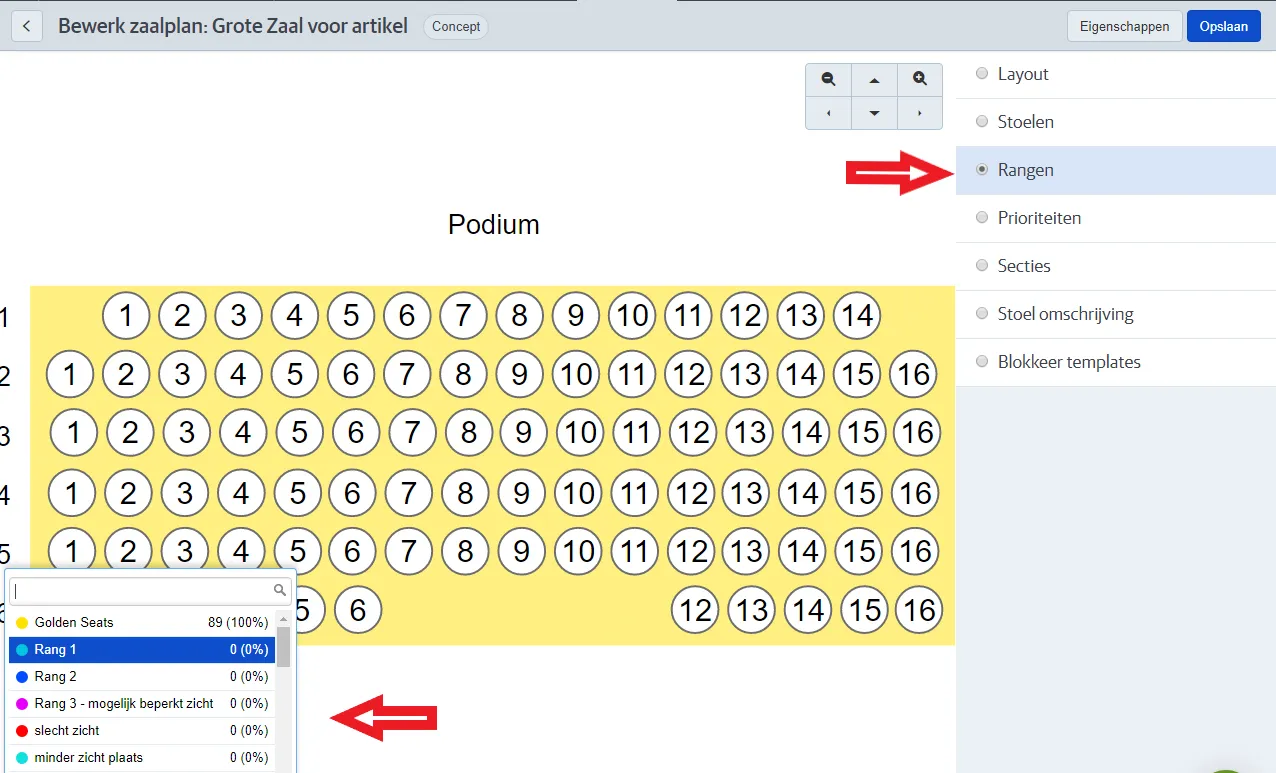
Select a rank in the menu, then use the brush tool to apply it to seats. Seats will change to the rank’s color. Click Save when done.
ℹ️ Hint: To add new ranks, first create them in Settings → Ranks
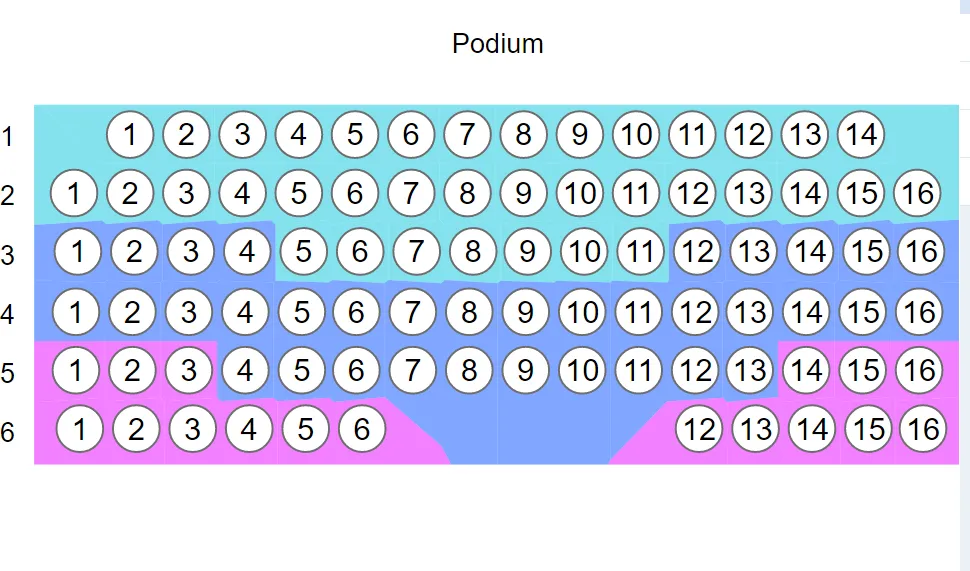
ℹ️ Info: Ranks let you assign different ticket prices to different areas. You can still adjust ranks later for individual events: Adjusting seat categories for a numbered event
Priorities
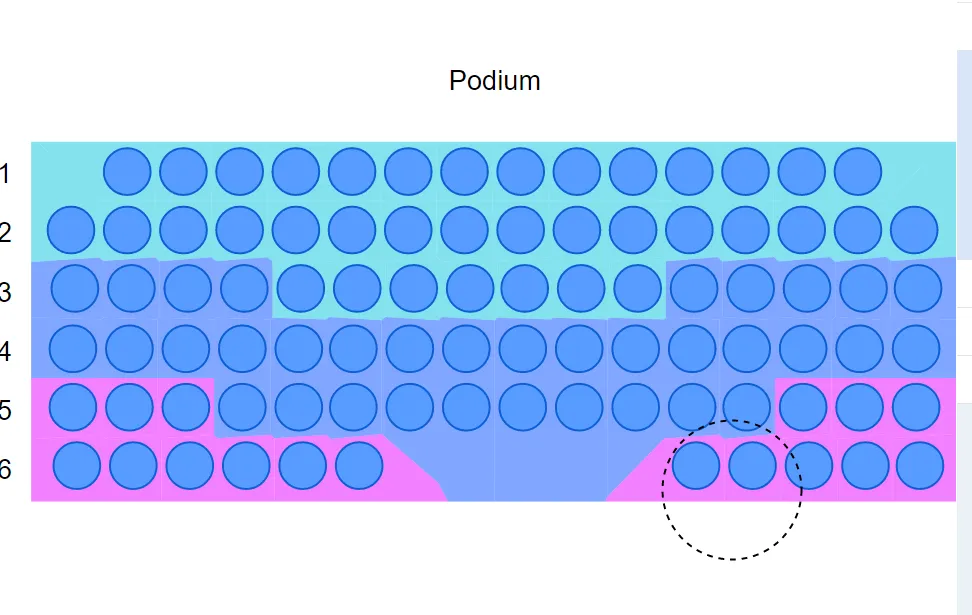
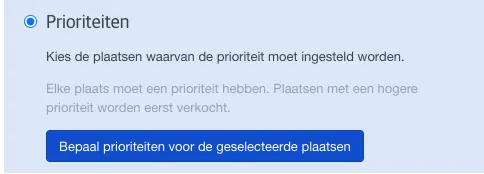
Priorities help assign the best seats during sales. Use the brush to select seats and then click Set priorities for selected seats.
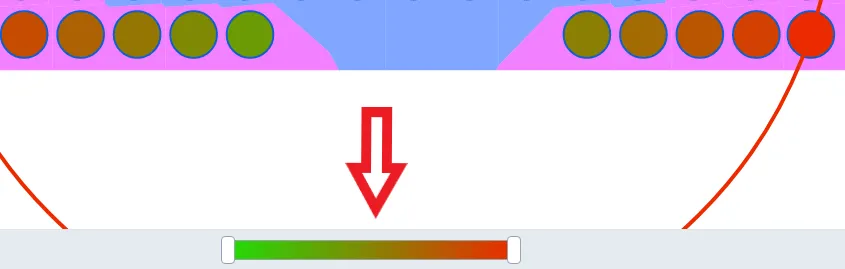
A color overlay indicates priority: green is highest, red is lowest. Adjust with your cursor.
Use the slider below to set the priority threshold.
Once priorities are set, click Finish to confirm.
Seat descriptions
Seat descriptions determine how customers see their seats on tickets.
You can set a single description for all seats or distinct descriptions per zone (e.g., balcony or entrance).
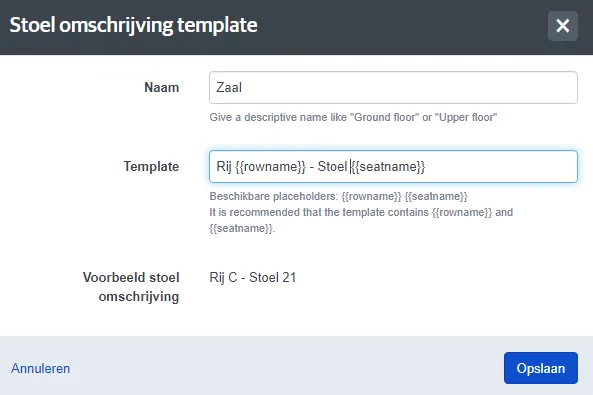
To differentiate certain seat descriptions, create a template via Add seat description template.
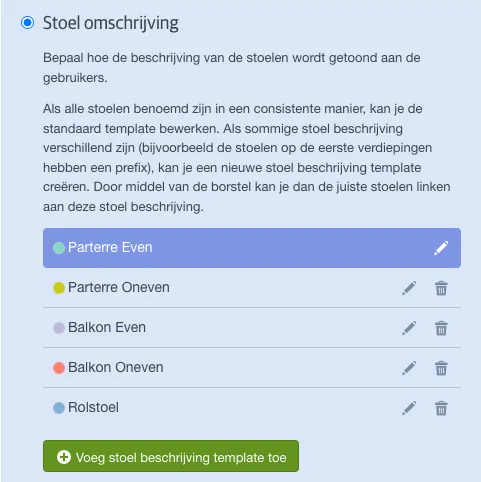
Once templates are created, select one and brush it onto seats—they will adopt the template’s color.
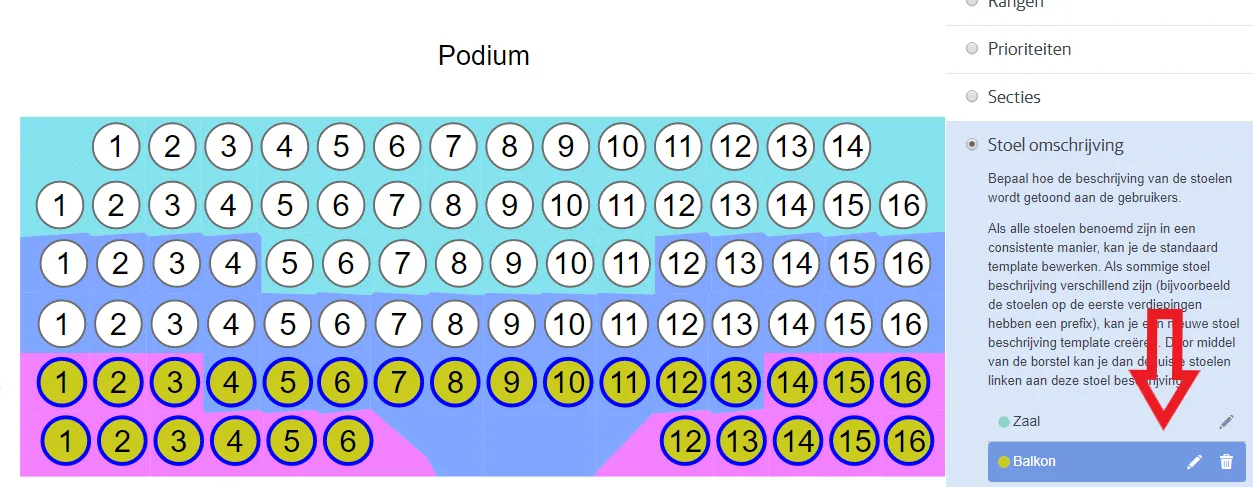
ℹ️ Info: You can still edit seat descriptions after publishing—the changes will appear in all events linked to this seating plan.
Block templates
Add block templates for elements like obstructed views—useful for different event setups.
ℹ️ Info: Block templates allow reusing the same seating plan for different configurations.
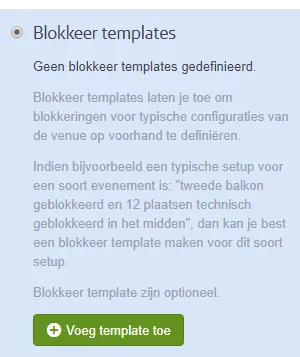
To add a block template, select Block templates and click Add template.
Choose a block type in the bottom left.
ℹ️ Hint: Want a block type not listed? First add it via Settings → Blocks: Managing locked tickets
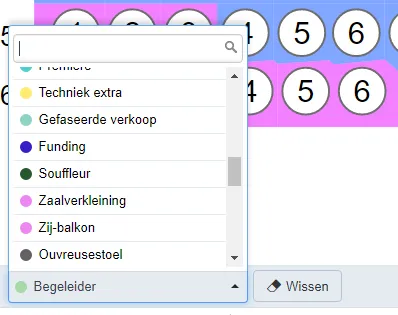
Use the brush to apply the block. Click Save when done.
The seating plan is now ready. Click Publish to make it active.
Properties (optional)
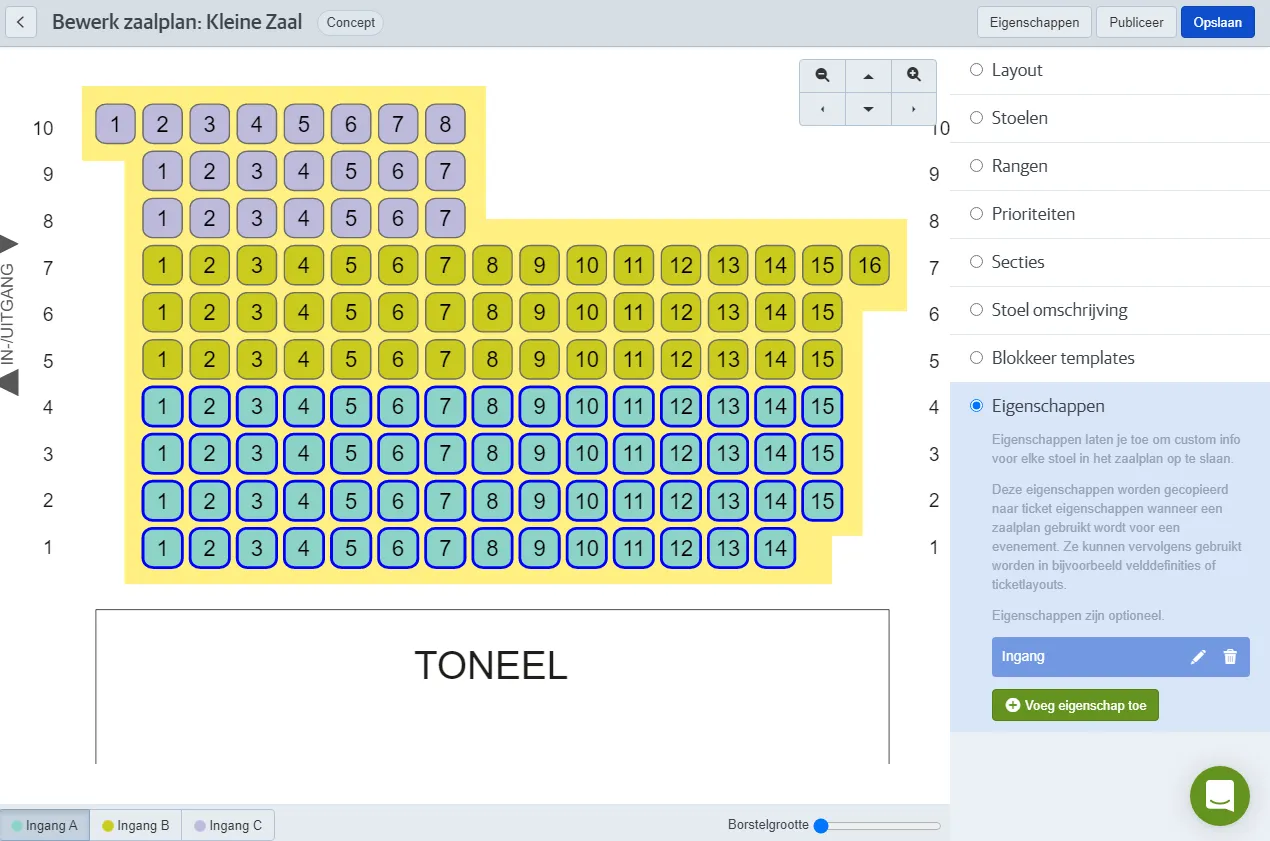
Properties let you assign seat-level attributes—like “entrance A” or a time slot, helping guide entry.
To use them on tickets, contact support for setup. Once enabled, follow these steps:
Select Properties, then click Add property.
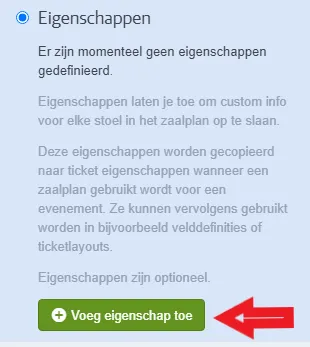
Enter a name and lowercase key (preferably matching the name).
Under Values, enter each variant, click ➕ after each, then add the next.
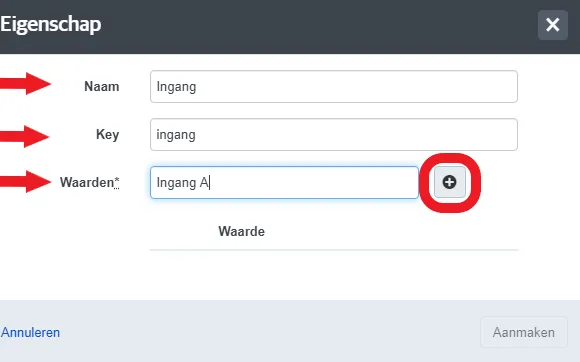
Once all values are entered, click Create.
Use the brush to assign properties to seats.